
Roll-to-Roll Large Area Manufacturing
Roll-to-roll manufacturing is a continuous and high throughput manufacturing scheme reliant on a continuous supply of substrate. When combined with vacuum-free industrial deposition methods such as slot-die coating, gravure printing, microgravure coating, screen printing methods on a low-low-cost substrate such as polyethylene terephthalate, high throughput low-cost manufacturing can be achieved. Widely used in printed electronics, this manufacturing method is highly suitable for solution-based OLED display, printed electronics, printed sensors and solar cells.
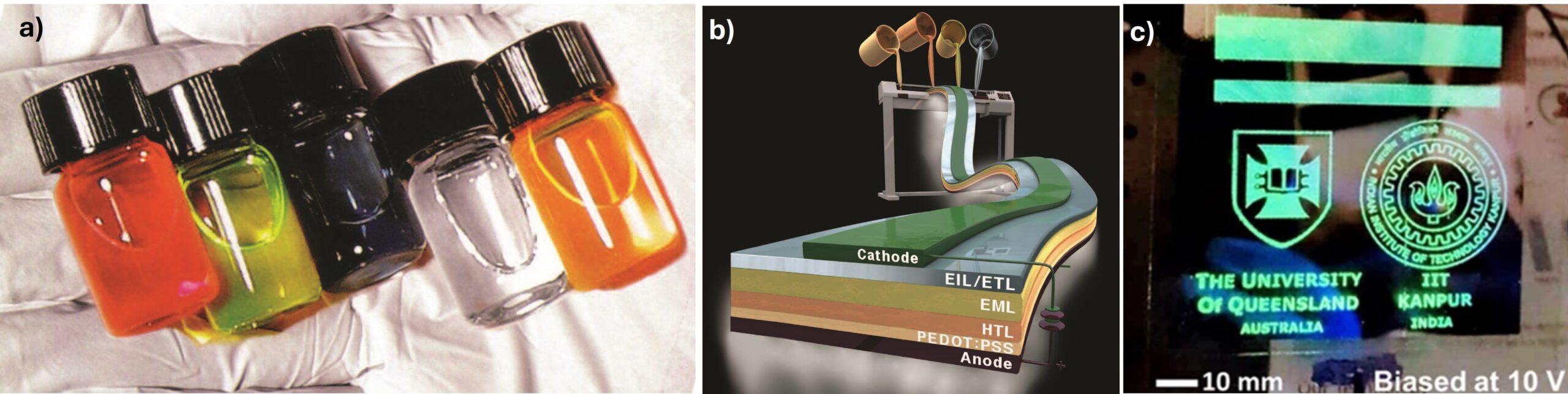
Figure 1 a) Vials containing semiconducting and metallic polymers in solution. The colored solutions are semiconducting polymers with different band gaps. The colorless solution contains a blue emitting polymer with absorption in the ultraviolet. The dark solution in the center contains conducting poly (ethylenedioxythiophene). b) The organic semiconductors in solution form can be used as “inks” and printed onto surfaces with any printing technology. [Reproduced from Semiconducting and metallic polymers; A. J. Heeger, N. S. Sariciftci, E. B. Namdas, Oxford University Press 2010]. c) Prototype large area ink-jet printed OLED using next generation of TADF material [Nature Communications, 14, 7220, 2023].
Solar Cells
The record power conversion efficiency (PCE) of 26.7% was recently reported for a single-junction PSC. This efficiency is comparable with mature technologies such as single-junction Si, CIGS, and CdTe solar cells. The high light-absorption coefficient of PSCs enables optimal photovoltaic (PV) performance with a sub-micrometer light-absorbing layer thickness, unlike hundreds of micrometers required in conventional solar cells. Additionally, their solution processability makes them compatible with scalable deposition through vacuum-free roll-to-roll printing and coating on low-cost, flexible substrates. The combination of these advantages has the potential to significantly reduce material and manufacturing costs, making PV manufacturing more accessible than conventional Si-based solar cells, which incur high capital costs, high energy-intensive processing steps, and slow production throughput.
CSIRO’s Printable PV team possesses deep expertise in the fabrication of high-performance printed solar cells and has achieved numerous world firsts in this field. Over the past decade, the team has developed R2R production capabilities for solution-based deposition of solar cells that have culminated in successful technology demonstrations in partnership with Australian industry. Building on their extensive experience with this earlier-generation solar cell technology based on printed organic inks, the CSIRO team made rapid progress in developing the potentially more efficient printed PSC technology. This leading-edge expertise and R&D outcomes led to the establishment of a bespoke Printed Photovoltaics Facility (PPVF) at CSIRO (Clayton Nth, VIC) to enable pilot-scale production trials aimed at accelerating the market readiness of the printed PSC technology. Current, research, development, and demonstration (RD&D) approach is shown in Figure 1. Through this project, CSIRO will work with UQ to develop quantum dot perovskite inks and test their scalability on the R&D line.
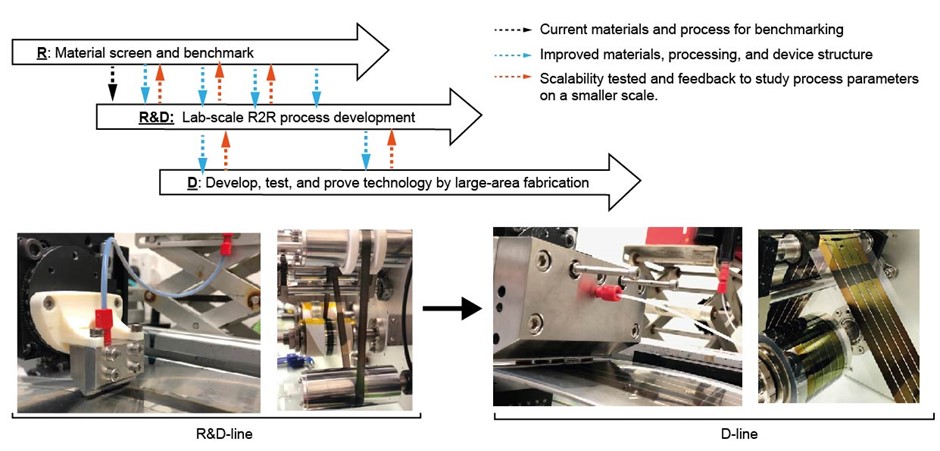
Figure 2 Roll-to-roll manufacturing development approach at CSIRO.
References:
- Nature Energy2023, 8, 789
- Nature Communications 2024,15, 1656. https://doi.org/10.1038/s41467-024-46016-1
- Advanced Functional Materials2022, 32, 2110700.
- Cell Reports Physical Science 2021, 2, 100293 .