
Bilayer 2D-3D Perovskite Heterostructure
A rationally designed 2D-3D perovskite stacking-layered architecture by in situ growing 2D PEA2PbI4 capping layers on top of 3D perovskite films was constructed to drastically improve the stability of perovskite solar cells without compromising their high performance. The conceptual design of bilayer 2D-3D heterostructures, as illustrated in Figure 1, pave the way to developing high-performance perovskite optoelectronics, including light-emitting diodes, photodetectors, lasers, and transistors.
Perovskite-MOF glassy composites
A new family of scalable composites can be fabricated through liquid-phase sintering of lead halide perovskite and metal-organic framework (MOF) glasses, enabling efficient surface defect passivation that impairs bright, narrow-band photoluminescence with a wide gamut for creating white light-emitting diodes. The processable composites show high stability against immersion in water and organic solvents as well as exposure to heat, light, air, and ambient humidity.
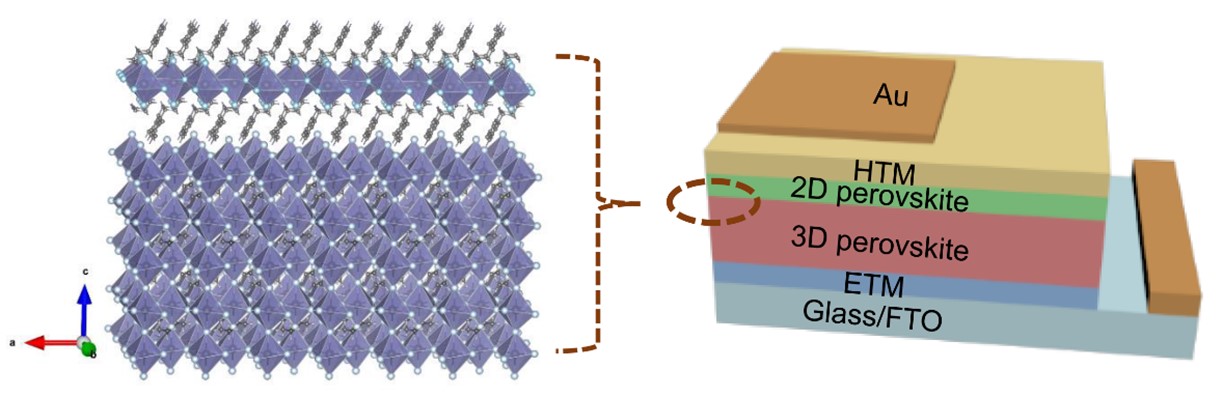
Figure 1 Schematic illustration of 2D-3D heterostructure for perovskite solar cells.
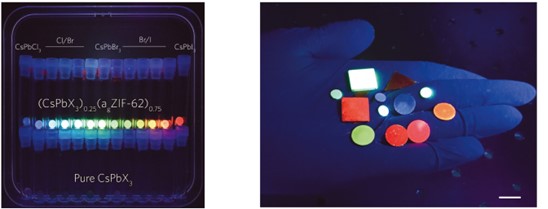
Figure 2 Photos of perovskites and their MOF glassy composites under UV irradiation.
References:
- Advanced Functional Materials 2018, 28, 1706923.
- ACS Nano 2023, 18, 67–88.
- Science 2021, 374 (6567), 621–625.
Lead researchers
Peng Chen
ARC DECRA Fellow
The University of Queensland, Australia
Julian A. Steele
ARC DECRA Fellow
The University of Queensland, Australia
Bright Walker
Asso. Professor
Kyung Hee University, South Korea
Toshinori Matsushima
Asso. Professor
Kyushu University, Japan
Jung Hwa Seo
Professor
University of Seoul, South Korea
Dechan Angmo
Senior Research Scientist
CSIRO, Australia
Ebinazar Namdas
Asso. Professor
The University of Queensland, Australia
Chihaya Adachi
Distinguished Professor
Kyushu University, Japan